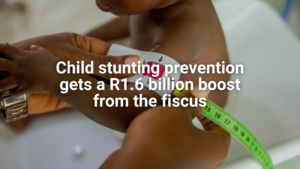
The South African government’s newly approved strategy to improve the lives of children and teenagers must be matched by an evidence-based social assistance policy that supports the nutrition and wellbeing of pregnant women.
President Cyril Ramaphosa is expected to outline the government’s plan of action in his State of the Nation Address, just two months after Cabinet approved the National Strategy to Accelerate Action for Children (NSAAC).
A coalition of NGOs and researchers advocating for a Maternal Support Grant (MSG) has welcomed the NSAAC, particularly the recognition that protecting poor and vulnerable pregnant women from malnutrition is critical for early childhood development.
Babies born to food-insecure mothers are more likely to have low birth weight (under 2.5 kg) and experience stunted growth, leading to long-term harm to brain development, poorer educational outcomes and reduced earning potential later in life.
The proposed MSG is a nine-month grant that:
- reduces low birth weight,
- would provide expectant mothers with income support equal to the Child Support Grant (CSG) from the second trimester of a confirmed pregnancy until three months after birth,
- costs about R2 billion annually, and
- can save 8 billion in societal costs.
The cost of not doing anything is higher, claiming children’s lives, stunting their growth and causing economic losses.
“Child malnutrition cannot be fully tackled without addressing maternal hunger — the first 1 000 days, starting in the womb, are critical for a child’s growth and development,” says Edzani Mphaphuli, coalition member and Executive Director of Grow Great.
Good child nutrition starts in the womb
The evidence is clear: pregnant women who eat better, feel better and are more likely to access antenatal care. Maternal hunger and poor mental health reinforce each other, undermining women’s ability to care for themselves during pregnancy. By easing financial stress, the MSG can improve child nutrition by enabling access to food and healthcare while supporting maternal mental wellbeing.
“Strengthening income support for pregnant women must form part of a coordinated response to child malnutrition, among other interventions that address food affordability and availability,” Mphaphuli adds.
Cabinet must greenlight an MSG policy
Government’s commitment to improved child nutrition must be the catalyst for approving an MSG policy, which has been under development by the Department of Social Development for more than a decade.
In 2024, a Cabinet sub-committee sent the draft MSG policy back to the department for further consideration, placing it in limbo.
Sceptics of the MSG claim, without evidence, that income support during pregnancy encourages young women to have babies or leads to widespread misuse of funds, but researchers who’ve investigated these claims found they are not true.
“On the contrary, women use grants to feed their families, and social assistance — such as the Child Support Grant (CSG) — helps protect against stunting. However, the CSG’s value must be increased, and access for infants improved, as nearly half of eligible babies do not receive it in their first year,” says Liezel Engelbrecht, nutrition lead for the Hold My Hand Accelerator.
“The MSG must be designed in such a way that recipients transition automatically to the CSG after a birth is registered and appears in government’s systems, ensuring continuity of support from pregnancy to those crucial early years,” Engelbrecht explains.
MSG advances equity
The MSG also advances gender equity by reaching unemployed women, women in informal work and female-headed households excluded from maternity protections and social assistance.
“Pregnancy places additional financial strain on already vulnerable households — many of them female-headed. Expectant mothers have greater nutritional needs, face higher transport costs to access healthcare and often experience reduced earnings and job insecurity. This is especially true for women working in the informal economy or relying on part-time or piecemeal work,” says coalition member Julie Mentor, Project Lead of Embrace.
“In addition, women face higher unemployment than men, deepening household food insecurity. Targeted social assistance, like the MSG, can therefore provide a vital economic lifeline to buy food and other essentials,” Mentor concludes.
About the MSG Advocacy Coalition: The MSG Advocacy Coalition is a growing collective of NGOs and researchers with members including Embrace, Children’s Institute, the Equality Collective, DG Murray Trust (DGMT), Ilifa Labantwana, Grow Great, Hold My Hand, SAMRC/Centre for Health Economics & Decision Science – PRICELESS SA, HEALA, Amandla.mobi, Health Systems Research Unit at SAMRC, Perinatal Mental Health Project, Union Against Hunger, Legal Resources Centre, and the Institute for Economic Justice.