DGMT’s strategy for helping South Africa escape the inequality trap is built around the same priorities set out in the National Strategy to Accelerate Action for Children (NSAAC) and we are working to weave them into everything we do.
Escaping the inequality trap involves changing a child’s life trajectory. A child who is nurtured, eats nutritious food and is ready to read and do maths by the time they go to school is on a different path compared to a child who is stunted, has poor early language development and no caring adult at home.
Skills beget skills, so a child with a strong start and quality schooling will have more chances to fulfil their potential. And when more people build the knowledge and skills needed to participate fully in the economy, we have the makings of a thriving society and a way out of the inequality trap.
Where our strategies meet
DGMT’s approach and the NSAAC share a common purpose: lifting the wellbeing and life outcomes of every child and teenager in the country. The NSAAC organises this ambition into 10 priorities:
- Strengthen families and enable parents & caregivers to care for their children.
- Reduce infant and child deaths.
- Eliminate HIV transmission to babies.
- Improve child nutrition.
- Grow children’s brain power through early learning and language development.
- Prevent disability in children and give those with disabilities the same opportunities as others.
- Protect children & adolescents from all forms of abuse, violence, injuries and harmful substances.
- Give adolescents good access to health care, including sexual & reproductive health.
- Increase participation in quality education and training and link school-leavers to work.
- Build adolescents’ sense of identity, agency and connectedness.
Why we are making the connection explicit in our work
We have mapped our work against the NSAAC’s 10 priorities, and we encourage other NGOs to do the same. If more of us locate our work within the NSAAC priorities, even loosely, we believe the sector as a whole would benefit by pulling in the same direction. It would become easier to see where efforts align, where there might be room to collaborate and where gaps remain. It’s clear that government action alone is not enough for the NSAAC to succeed. Realising children’s rights requires a broad, collective effort across all sectors of society — families caring for their children, government running the services that back them up and civil society and the private sector adding capacity and reach where it’s needed.
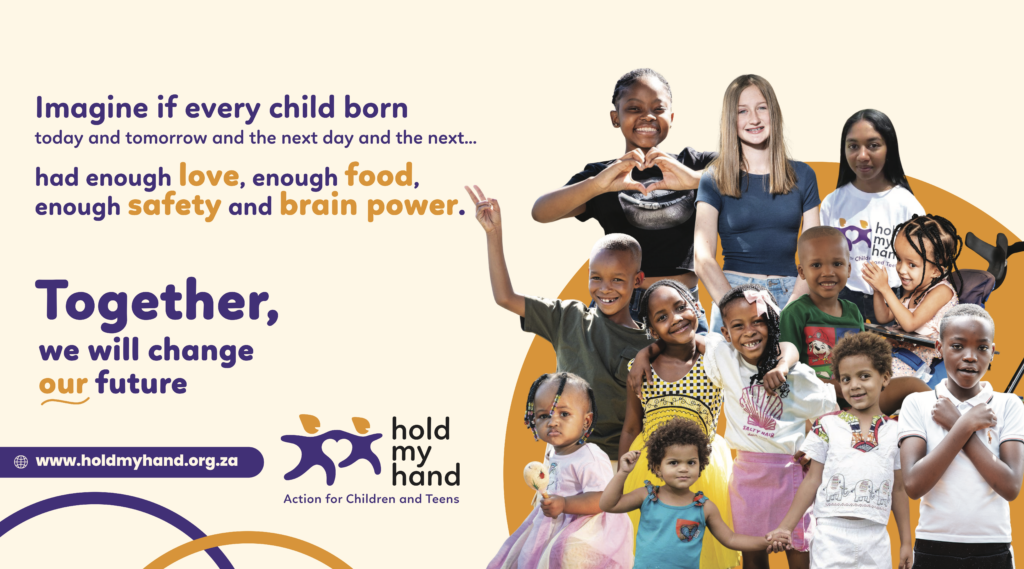
The strategy is championed by Hold My Hand, a national campaign mobilising action for children and teens. If you work with, or for, children, there is a role for you in this collective effort.
Join the Hold My Hand community and be part of the movement for children.