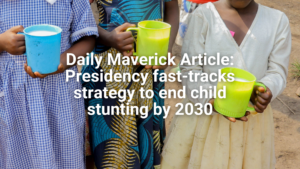
South Africa’s food systems are failing the poor: a quarter of our population has limited access to food and one in four children under the age of five is stunted due to chronic malnutrition. This is because food is unaffordable for many households that rely on social grants as their main source of income. For instance, the monthly Child Support Grant of R560, which reaches about 13 million children is 41% below the average cost of a monthly food basket of R5 380,62. This problem is not only about affordability but of quality and accessibility. Cheap ultra-processed foods, consumed by many living in low-income communities, may stave off hunger but they lack protein and essential micronutrients that people need to be healthy.
Food affordability, quality and accessibility are the cornerstones of dignity, health and resilience. Until our national policies address all three dimensions, our country’s food systems will continue to embed inequality instead of unlocking opportunity. These policies must tackle how food is produced, wasted and how it reaches households. This is where agroecology and enabling women farmers can make a big difference.
Put simply, agroecology is about finding ways to farm that are good for local markets, communities and nature. It makes food more affordable by lowering input costs and simplifying supply chains. Agroecology promotes the growth of nutrient-dense crops and decentralises agricultural production through home gardens, community food hubs and smallholder networks, making fresh produce more accessible. Agroecology also strengthens resilience — of people and the environment — helping to restore soil and water systems and protect households against climate shocks and food inflation. It also offers rural women, in particular, a chance to reclaim their roles as stewards of land, to become innovators in community-based food markets and custodians of seed systems.
In South Africa, more than 40% of households are headed by women. People in rural communities have long been growing their own produce for sustenance. In these areas, women lead over half of South Africa’s agricultural households, a clear sign of their critical role in sustaining our food systems. Yet, the women holding households together are not well considered in agricultural policy, which is why they are not getting enough state funding, support and recognition.
Now, new research commissioned by the DG Murray Trust (DGMT) shows how civil society is supporting rural women in agroecology with models that can be scaled through partnerships with government and better policies.
In KwaZulu-Natal, the Umgibe Farming Organics and Training Institute offers a women-centred, sustainable solution to household food insecurity. Starting with a simple “farm in a bag” technique using recycled plastic (now biodegradable), Umgibe has grown into a training hub supporting over 600 smallholder farmers and 41 cooperatives, enabling more than 290 families, primarily women, to produce and market organic vegetables. The system is water-efficient, low-input, and rooted in circular economy principles.
Staying in the province, women farmers have built agroecology enterprises at the Siyavuna Abalimi Development Centre on the South Coast. Marketing under the brand Kumnandi, they sell fresh and processed organic produce while adhering to a Participatory Guarantee System (PGS) that ensures quality without the prohibitive cost of formal certification. Siyavuna supports about 1 500 farmers — mostly youth and women — and has developed value-added products that bring new income streams into rural households.
In Mtwalume, also in KwaZulu-Natal, Thanda has shown what’s possible when women farmers receive ongoing support. Eighty-five per cent of their produce is consumed locally, directly strengthening household food security. Thanda’s model, with 30 full-time mentors working alongside women farmers, proves that small-scale farming can be a viable local economy when women are equipped with resources, training and market access.
Looking nationally, the SaveAct model has built savings groups with over 110 000 members, predominantly women, who use their savings to invest in farming and improve household resilience. In many cases, the ability to save and reinvest has allowed women to diversify crops, improve soil health and generate small but steady incomes. When women control financial resources, studies show that families spend more on food, education and healthcare.
Research shows that 78% of agroecological initiatives in low and middle-income countries were linked to improvements in household food and nutrition outcomes. Women participating in agroecology can lead to better nutrition outcomes. In South Africa, this plays out in several ways: women farmers are the main custodians of indigenous and nutrient-rich crops such as sorghum, cowpeas, amaranth, and spider plant — foods that diversify diets and strengthen resilience against malnutrition. And initiatives like Thanda ensure that surplus food is channelled into school feeding schemes and early childhood development centres, directly improving children’s diets.
If national policy does not recognise and resource women farmers, their contribution to nutrition and household food security will remain invisible. With the forthcoming Agroecology Framework expected to open for public consultation, we have an opportunity to influence national policy.
Securing land access, funding women-led businesses, supporting mentorship and training, and guaranteeing women’s representation at the decision-making table are essential. Equally urgent is reforming restrictive seed laws and formally recognising indigenous knowledge — much of it held and passed down by women.
The evidence is undeniable: empowering women farmers produces healthier children, stronger families and resilient food systems.
Sibongiseni Peacock is an innovation manager at the DG Murray Trust focused on building productive synergies between communities and the environment.
The Mercury and the Cape Times originally published this op-ed on 16 September 2025.