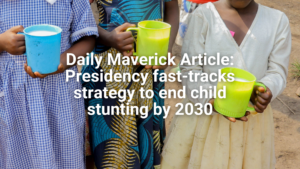
On 7 April 2025, Western Cape MEC of Health and Wellness, Mireille Wenger, delivered her budget speech in which she tackled a hard reality: over a quarter of children under five in South Africa are stunted.
MEC Wenger pointed out that stunting isn’t just a health issue; it limits a child’s potential in every way. Children who are stunted are more likely to struggle in school, face economic hardship later in life, and live with long-term health issues. Preventing stunting early is crucial. This is why she announced a new pilot programme developed in partnership with the Department of the Premier and DGMT, to support the nutrition of pregnant women, specifically underweight pregnant women, those at risk of low birth weight babies and mothers who have delivered babies under 2.5kg.
The pilot programme aims to tackle an early warning sign of stunting: low birth weight. Research shows that babies born underweight are three times more likely to be stunted between six and 24 months of age. And the window for prevention starts early, in the womb.
From a pregnant mother’s first clinic visit until their baby turns six months old, underweight and at-risk pregnant women will receive monthly nutritional support. They’ll also have regular contact with trained community health workers, who will provide growth monitoring, health services for mothers and babies, breastfeeding counselling, mental health support and information about maintaining healthy pregnancies.
For DGMT, this partnership is a strong example of what can be achieved when government and civil society work side by side. Stunting isn’t just a childhood issue — it affects learning, future earnings, and the economy. It’s one of the reasons why the average child born today is expected to reach only 43% of their full productive potential as an adult.
This pilot, which will run until October 2026 in Worcester, Khayelitsha and Mitchell’s Plain, is a step towards preventing stunting and responding to warning signs in the crucial first six months of life. It is one of the ways in which provincial and national governments can support pregnant women. On a national level, there’s a need for social assistance in the form of a Maternal Support Grant. Research shows that a child’s health is shaped from the earliest stages of pregnancy, which highlights the need for policies that prioritise maternal nutrition.
There’s strong evidence to support this kind of early intervention. A review of pregnancy support programmes across 27 low- and middle-income countries found that financially supporting pregnant women can reduce maternal anaemia and help prevent low birth weight.
Liezel Engelbrecht, Nutrition Lead for the Hold My Hand Accelerator, incubated by DGMT, says: “Now is the time to push for action. The cost of inaction? A cycle of poverty and poor health.”
Read MEC Wenger’s full speech here or watch it below, and read a recently published op-ed about the Maternal Support Grant.