The Learning Lunch podcast explores ideas, approaches and social innovations – creating opportunity for non-profit organisations’ teams to discover what others are learning and space to reflect on what these insights might mean for their own strategy and programme implementation.
What comes to mind when you hear the term ‘social protection’? For many, it’s social grants or government assistance programmes. But at its core, social protection is a safety net that keeps people from falling deeper into poverty, benefiting individuals and society.
In South Africa, even though this principle is embedded in the Constitution, there are still gaps in our social protection system. Pregnant women living in poverty are falling through the cracks. Without financial support during pregnancy, women living in poor communities face greater economic hardship, limiting their ability to work and making it harder to afford nutritious food and healthcare. Right now, South Africa doesn’t have a dedicated social grant for expectant mothers living in poverty. Yet research shows that providing financial assistance during pregnancy leads to healthier babies and better long-term outcomes.
This matters for NGOs working on the frontlines of social development. The people most in need of social protection are often the very same communities that NGOs serve — whether in maternal health, early childhood development, or food security.
A Maternal Support Grant (MSG) wouldn’t just change lives at an individual level; it could also ease the burden on NGOs because stronger state support for pregnant women has the potential to break cycles of intergenerational poverty.
In this Deep Dive conversation, we look at what a Maternal Support Grant could mean for South Africa, why it’s a social justice issue, and how NGOs can help push this conversation forward. We speak to Wanga Zembe-Mkabile, senior specialist scientist at the South African Medical Research Council; Julie Mentor, Project lead of Embrace and Daniel McLaren, a public finance economist at Ilifa Labantwana.
Daniel McLaren joined Ilifa Labantwana as a Public Finance Economist in 2023, focusing on financing solutions to expand access to quality early childhood development (ECD) services. His work includes research on funding models, economic modelling, developing an ECD investment case, engaging in Parliamentary budget processes, public advocacy, and providing technical support to government for improved planning and systems change. He holds an MPhil in Human Rights Law from the University of Cape Town and is a founding member and former chairperson of the Budget Justice Coalition—a network of over twenty civil society organisations advocating for transparent, accountable budgets and progressive tax and spending reforms to meet South Africa’s social and developmental needs.
Wanga Zembe-Mkabile is an NRF C-rated researcher who works as a Senior Specialist Scientist in the Health Systems Research Unit of the South African Medical Research Council, where she leads the Social Policy and Health thematic area. She has Master’s and PhD qualifications in Social Policy from the University of Oxford. Her interests are research and teaching in social policy, insofar as this relates to social determinants of maternal and child health. Her research mainly focuses on the potential role of social protection instruments in mediating the relationship between these determinants and poor health and wellbeing outcomes. Wanga’s research has been published in multiple international journal articles, book chapters, and working papers.
Here are some complementary bites to make your meal even tastier
Watch our most recent Perspectives event, focusing on the Maternal Support Grant.
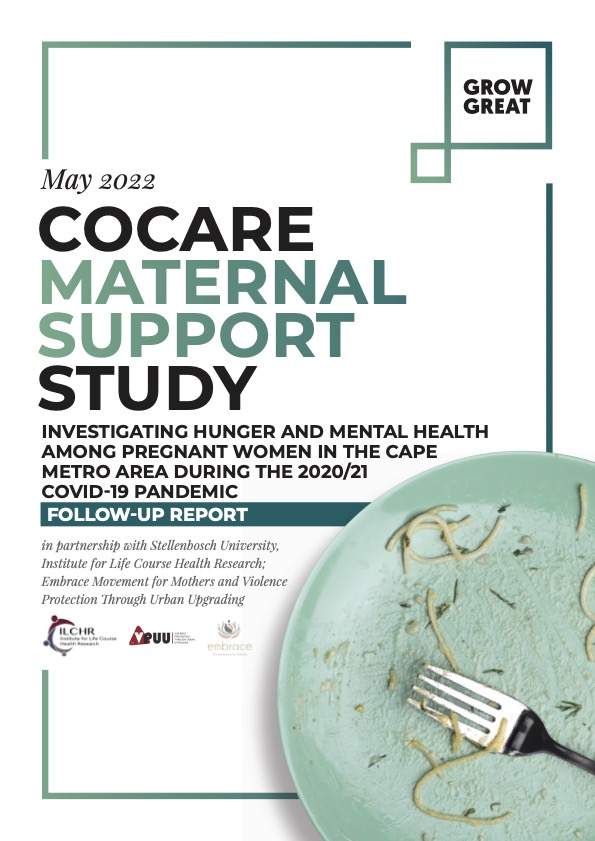
Download the CoCare maternal support study on the left.
This report details the findings from the CoCare study, which looked at the effects of providing pregnant women and new mothers with a digital food voucher between 2020 and 2021, and focuses on the follow-up phase. Respondents in the baseline CoCare survey were more likely to report food insecurity and poor mental health than respondents within the NIDS-CRAM study (general population survey).
Explore our media appearances relating to the Maternal Support Grant.

ENCA Interview: Pilot programme to support the nutrition of pregnant women


Op-ed: Three powerful arguments in support of the Maternal Support Grant