
Global Health Now Article: Nutrition Granted – Fighting Low Birth Weight in South Africa

A half dozen pregnant women sit around a table, singing lullabies to the water bottles they are cradling to their chests as if breastfeeding. The women, members of a pregnancy support group at a clinic in Johannesburg’s Soweto section, erupt into laughter at the exercise. “The Flourish [group] has been eye-opening, in a good way […]
Hands-on Learning Issue 35
Through the Hands-on Learning publication, we hope to play a helpful role in synthesising information from innovators and implementers in civil society, supporting them to share what they have learnt so that others can draw from and build on their experiences. Starving the fuel to its fire: Why curbing heavy drinking can help lower gender-based […]
Learning Brief – Starving the fuel to its fire: Why curbing heavy drinking can help lower gender-based violence in South Africa
About a third of South African women over 18 have experienced physical or sexual violence in their lifetime. Add to that the fact that about seven women are killed in the country every day — in about 90% of cases at the hand of an intimate partner or family member. Gender-based violence (GBV) is not […]
Learning Brief – Finding their footing: How public employment programmes can support young people in crafting a better life
For millions of young South Africans, the path from learning to earning is neither clear nor guaranteed. Almost four in 10 young people aren’t working or in education or training, and the response hasn’t kept pace with the scale or complexity of the crisis. The problem has many sides: a labour market that can’t absorb […]
Learning Brief – Early identification, early access: Why universal early hearing screening makes sense for South Africa
International guidelines recommend that all newborns should have their hearing tested within one month of birth. If they have hearing loss, they should be formally diagnosed by three months of age and receive appropriate intervention by the time they are six months old. But South Africa doesn’t have a national policy for universal newborn hearing […]
Western Cape stunting-prevention pilot reaches over two thousand women, with more to come before end of 2026
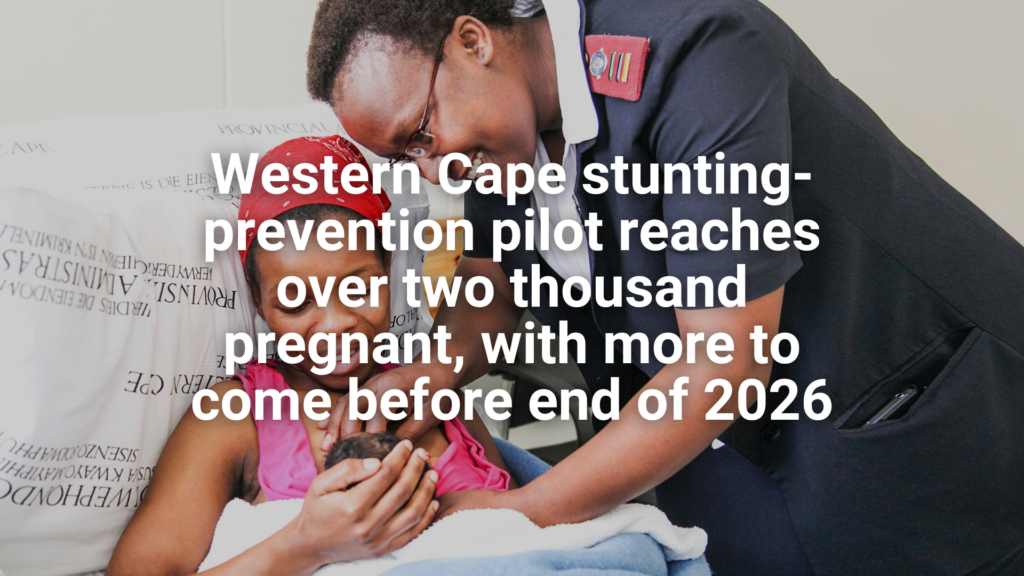
A pilot programme tackling stunting in parts of the Western Cape has enrolled over 2 200 women since it began in August 2025. Khulisa Care — “to grow” in isiXhosa — gives underweight and at-risk pregnant women, and mothers of low-birth-weight babies, monthly nutrition support from Shoprite, alongside targeted primary healthcare from trained community health […]
Metro Lives: What can municipalities do for children?
Children don’t vote — but local government decisions shape their lives every day. Whether a child has a safe place to play, a park worth walking through, clean water, a registered early learning programme nearby, or a neighbourhood with more libraries than liquor outlets: these are municipal choices. Metro Lives is a series of public […]
We care about men. Here’s why you should too
It should not be controversial to say we must care about boys and men. But in today’s culture wars, this statement risks being read as an endorsement of the argument that men are the victims of progress and gender equity policies — and feminism has gone too far. It is not. Caring about boys and […]
Radio 702 Interview: A model to improve public schools
The Supreme Court of Appeal has dismissed challenges by Sadtu and Equal Education to the Western Cape’s school reform laws. The court found that provinces are allowed to legislate on education, and that collaboration and donor-funded schools count as public schools even though they work differently from the ones described in the South African Schools […]
Cape Talk Interview: School reform – Could a new court ruling change how SA’s public schools are run?

The Supreme Court of Appeal has dismissed challenges by Sadtu and Equal Education to the Western Cape’s school reform laws. The court found that provinces are allowed to legislate on education, and that collaboration and donor-funded schools count as public schools even though they work differently from the ones described in the South African Schools […]